Collective guilt and second-generation responsibility
The ReaderCollective guilt and second-generation responsibility name a central postwar dilemma in the novel: how can the children of a society shaped by Nazi crimes investigate and condemn the past without pretending that accusation alone makes them innocent? The question takes institutional form in a student seminar following a camp trial, then becomes personal for Michael Berg, whose love for Hanna makes the distance between judgment and implication impossible to maintain. The novel presents responsibility as historical and moral rather than as a simple inheritance of criminal guilt: the second generation must confront what was done, what was tolerated after 1945, and what its own acts of memory and judgment can—and cannot—repair.
The Seminar and the Judgment of a Generation
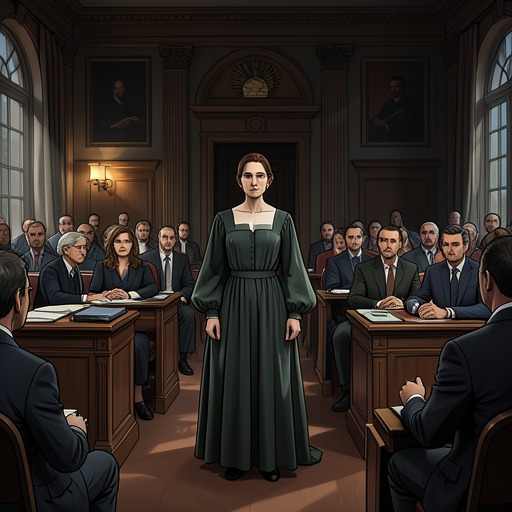
A university professor makes a camp trial the subject of a seminar so students can follow its proceedings and assess them. The case is neither the first trial concerning the camps nor one of the major trials, but its sustained schedule gives the students a way to examine both the evidence and the society in which the crimes occurred. The seminar debates the prohibition of retroactive justice: whether it is enough that the relevant ordinances were already on the books when crimes were committed, or whether their interpretation and enforcement at the time also matter. Beneath that legal question lies a larger one about what law means when a society fails to enact or obey what justice requires.
The students understand their inquiry as an act of exposure. Calling themselves explorers of the past, they imagine that bringing evidence into the open will disperse the social silence surrounding the camps. They consider convictions necessary, but not sufficient: the prosecution of individual guards and enforcers is only a beginning. In their view, the generation that benefited from those perpetrators, failed to stop them, or allowed them to remain in society after 1945 is also answerable. Their language turns the seminar into a moral tribunal, one in which the older generation is judged not only for direct participation but for accommodation and inaction.
That judgment reaches the students’ own families. Their parents had occupied varied positions during the Third Reich: some fathers served in the war, including as Wehrmacht or Waffen-SS officers; others had worked in the judiciary or local government. The group also included parents who were teachers and doctors, and a student whose uncle held a senior post in the Ministry of the Interior. Michael’s father, by contrast, had lost his philosophy lectureship after scheduling a lecture on Spinoza and supported his family during the war by editing hiking maps and books. Michael nevertheless remembers condemning him to shame, even though he could not bring a charge beyond the parents’ postwar tolerance of perpetrators. The episode exposes the difference between identifying a specific criminal act and assigning responsibility for the social conditions that let perpetrators remain accepted.
The seminar gives its members a strong collective identity: other students call them the students of the camps, and they adopt the name themselves. Their insistence on repeatedly exposing the horrors alienates some of their peers. Looking back, Michael recognizes that their eagerness to make others confront the evidence could itself repel. The students’ certainty that they must enlighten and accuse grows with the horror of what they learn. The narrative therefore subjects their activism to retrospective scrutiny: a desire to break silence may be morally serious, yet the performance of accusation does not automatically amount to understanding or escape from shame.
The Limits of Inquiry and the Burden of Shame
During the trial, Michael asks what his generation should do with knowledge of the extermination of the Jews. He resists the idea that the horrors can be fully comprehended or made ordinary subjects of discussion, but he also questions whether silence in revulsion, shame, and guilt is an adequate response. The dilemma is not between remembering and forgetting so much as between two inadequate forms of response: treating atrocity as an object one can master, and refusing inquiry because the subject exceeds comprehension. The seminar’s investigative confidence remains, but the courtroom makes its limits harder to ignore.
Michael’s experience is sharpened by emotional numbness. He watches the trial daily and finds that the judges and lay members, visibly shocked in the early weeks, gradually return to ordinary expressions and even show impatience when testimony falters. Prosecutors also lose some of their initial capacity to sustain their response to the evidence. Michael sees this habituation as part of a wider danger: repeated exposure can make horror seem like ordinary scenery. He compares the numbness found among perpetrators, victims, survivors, and those listening to the trial, but insists that such a comparison must not erase the decisive difference between being forced into the camps and entering that world voluntarily, or between suffering and inflicting suffering.
The novel links this public problem of habituation to the ways historical memory is formed. Michael’s images of the camps are initially sparse: photographs of Auschwitz and Birkenau, objects associated with deportation and murder, images from Bergen-Belsen, and survivor testimony that had disappeared from publishers’ lists for years. Later, television and films expand the camps’ place in collective imagination, but they also supplement and embellish what viewers know. In Michael’s student years, the limited images return until they harden into clichés. His visit to Struthof does not simply correct them: the impressions of the camp join his existing images and freeze alongside them. The effort to make history tangible thus encounters the limits of representation as well as the risks of distance and repetition.
Historical Responsibility and Generational Conflict
When Michael later considers the student upheavals, he distinguishes awareness of political events from participation in them. He has finished his studies and begun his legal training; although he remains close enough to the university to know what is happening, he has little interest in reform agitation or demonstrations. He is especially removed from other students’ efforts to confront the Nazi past. His distance does not mean that the issue has ceased to matter. Rather, it has become inseparable from the discomfort of his own relation to the people being judged.
Michael questions whether dealing with the Nazi past was the cause of the generational conflict or the form through which it was expressed. Children in every generation must free themselves from parental expectations, but the Third Reich compromised the older generation’s authority: those who had committed crimes, watched them happen, looked away, or tolerated criminals after 1945 could hardly claim an untroubled right to instruct their children. At the same time, the past remained an issue even for young people who had no accusation to make against their own parents, or did not wish to make one. For them, confronting that history was not simply a vehicle for rebellion; it was itself the substance of the moral and political question.
Michael describes collective guilt as a lived reality for his generation while leaving its moral and legal validity unresolved. The shame he recalls is attached not only to crimes committed under the Third Reich but also to postwar continuities: Jewish gravestones defaced with swastikas, former Nazis pursuing careers in courts, administration, and universities, and the Federal Republic’s delayed recognition of Israel. He also notes how rarely emigration and resistance, rather than conformity, were handed down as traditions. Pointing to identifiable guilty people could transform shame from passive suffering into energy and aggression, but it did not make the shame disappear. The effort to confront the past thus carries both a public purpose and a personal cost.
Michael, Hanna, and Responsibility Without Innocence
Michael’s private dilemma makes the generational argument more difficult than a clean division between accusers and perpetrators. His parents are not people he can straightforwardly charge with crimes, and his earlier zeal in condemning his father embarrasses him in retrospect. Yet the guilt of others around him is, in his judgment, less grave than Hanna’s actions. He has to point at her, but the gesture turns back on him: he loved her and chose her. He tries to separate that love from knowledge of her past, and to imagine that his ignorance leaves him innocent. The novel makes that defense unstable by distinguishing a child’s unchosen love for parents from Michael’s relationship with Hanna, whom he did choose.
This conflict is not resolved by simply identifying Michael with the older generation’s perpetrators, nor does his love cancel Hanna’s responsibility. The point is that moral judgment cannot be made comfortable by setting oneself wholly outside the history under judgment. Michael envies students who dissociate themselves from their parents and from the generation of perpetrators, bystanders, and accommodators, but he distrusts the self-righteousness that can accompany such separation. He wonders whether declarations of dissociation merely drown out the enduring complicity that love for one’s parents may entail. His question does not establish that all forms of responsibility are equal; it unsettles the assumption that condemnation alone guarantees moral distance.
The trial’s emotional atmosphere also enters Michael’s intimate memories. As Hanna is accused, memories of their relationship coexist with the images of her as a camp guard; his feelings are numb, and the memories can seem detached from the person who lived them. He later recognizes that imagined scenes and familiar visual clichés undermine and merge with his actual memories of Hanna. That interweaving makes private recollection an imperfect route to historical knowledge: the loved person cannot be kept separate from the accused person, but memory cannot by itself supply a complete account of the camps or settle the question of judgment.
No Consolation in Shared History
Only later does Michael understand his personal pain as part of a broader German and generational predicament. That recognition brings no comfort. The fact that his difficulty loving Hanna while judging her resembles a wider problem does not reduce the difficulty or absolve him. He even wishes he could have felt himself part of his generation at the time, suggesting that shared responsibility might have offered a form of belonging without providing a solution.
The concept therefore remains deliberately unsettled. The novel distinguishes legal guilt from a wider moral burden, individual crimes from the postwar tolerance that helped perpetrators remain present, and historical understanding from exculpation. It also refuses to make the second generation’s shame a substitute for the suffering of victims or a claim to equal culpability. Responsibility begins in the work of looking, remembering, and judging, but the novel tests the easy satisfaction that can come from accusing others. For Michael, confronting the past means acknowledging that judgment is necessary and that love, memory, and inherited history keep him from imagining himself entirely outside it.